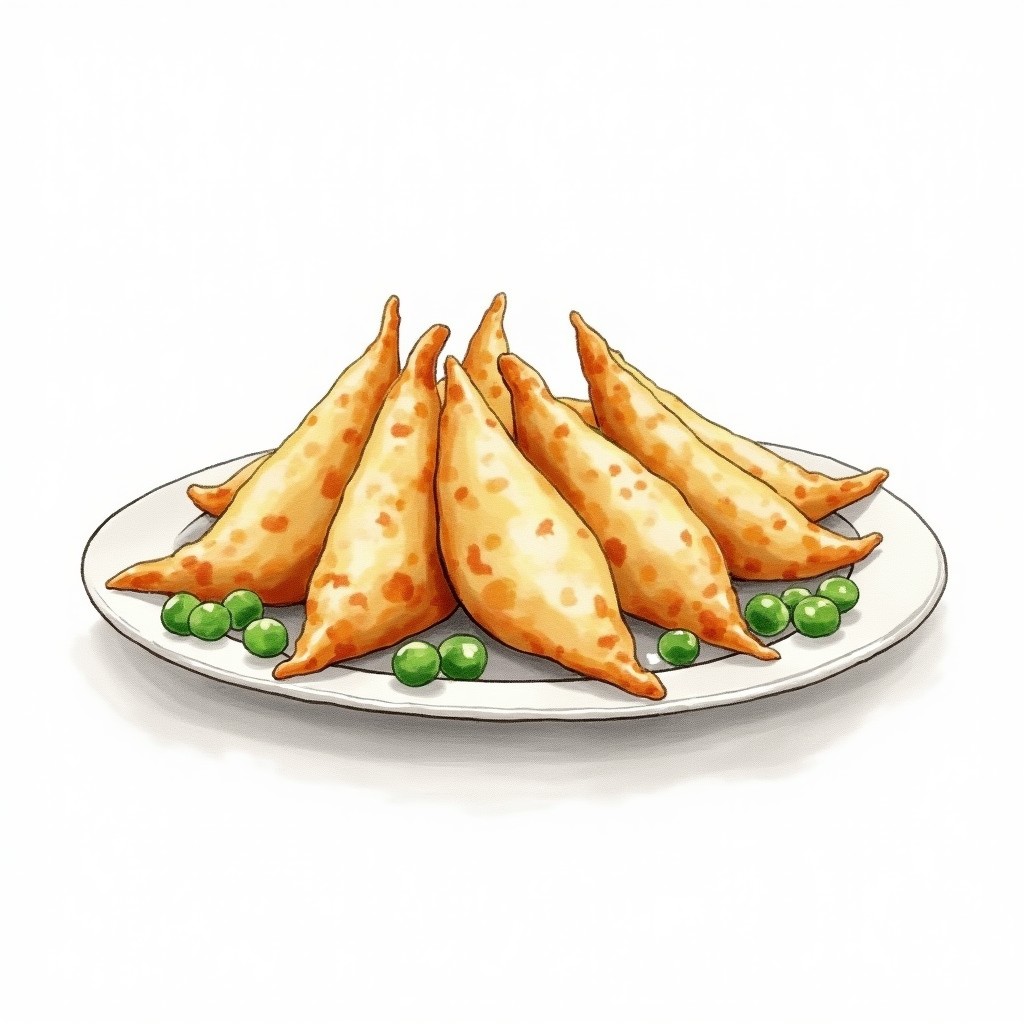
Vegetable Samosas
Golden Vegetable Samosas — Crispy Triangular Pockets Packed With Aromatic Spiced Filling
These hand-shaped beauties require some patience to fold properly, but once you master the technique, you'll have a party-worthy snack that disappears fast. The potato-pea filling gets its depth from bloomed whole cumin seeds and a careful balance of warming spices.
The first time you nail the samosa fold, something clicks — the way the dough stretches just enough, how the filling stays put, the satisfying crimp that seals everything tight. It's one of those techniques that looks impossible until suddenly it isn't, and then you'll find yourself making excuses to practice.
Samosas trace their roots through Central Asia to the Indian subcontinent, where countless regional variations have evolved over centuries. What they all share is that perfect marriage of flaky pastry and spiced filling, plus the satisfying ritual of shaping each one by hand. The dough here gets its particular texture from oil worked directly into the flour — it creates layers that puff and separate when they hit hot oil, giving you those coveted crispy shards.
This version leans into the comfort of potato and peas, but the real flavor comes from tempering the cumin seeds properly and getting the spice balance just right. The filling needs to taste a little stronger than you'd want to eat straight — it mellows inside that protective pastry shell. Once you master the basic technique, you can swap the filling for anything that strikes you: spiced lentils, seasoned meat, or whatever leftovers need transforming into something special.
Nutrition
Ingredients
Dough
- 2 cupall-purpose flour
- 4 tbspvegetable oil
- ½ tspsalt
- ½ cupwater, lukewarm
Filling
- 3 mediummedium potatoes, boiled until fork-tender and diced small
- 1 cupgreen peas, fresh or frozen
- 1 mediummedium onion, finely chopped
- 2 clovegarlic cloves, minced
- 1 tspfresh ginger, minced
- 1 tspcumin seeds, whole
- 1 tspcoriander seeds, ground
- ½ tspturmeric powder
- ½ tspgaram masala
- 1 tspsalt
- 2 tbspvegetable oil for cooking
- 4 cupvegetable oil for deep frying
Instructions
- Combine the flour, oil, and salt in a large bowl, rubbing the mixture between your fingers until it feels like coarse breadcrumbs. Slowly add the water while stirring, then knead the dough for 5 minutes until it becomes smooth and firm — it should feel slightly stiffer than bread dough. Cover with a damp towel and let rest for 30 minutes.⏱ 30 min
- Warm 2 tablespoons of oil in a large skillet over medium heat. Drop in the cumin seeds and let them sizzle for 30 seconds until they smell nutty and turn a shade darker — this releases their essential oils for maximum flavor.⏱ 30 sec
- Stir in the chopped onion and cook for 4 minutes until softened and lightly golden. Add the garlic and ginger, stirring constantly for another minute until fragrant — don't let them brown or they'll turn bitter.⏱ 5 min
- Add the diced potatoes, peas, ground coriander, turmeric, garam masala, and salt to the pan. Toss everything together and cook for 3 minutes, lightly mashing some of the potatoes to help bind the mixture. Remove from heat and cool completely — hot filling will make your dough soggy.⏱ 3 min
- Divide the rested dough into 12 equal portions. Roll each piece into an oval about 6 inches long, then cut it in half with a sharp knife to create two semicircles. Keep the pieces covered to prevent drying.
- Take one semicircle and form a cone by overlapping the straight edges slightly, sealing with a dab of water. Fill the cone with 2 tablespoons of the cooled filling, then brush the open edge with water and pinch firmly to seal, making sure there are no air pockets trapped inside.
- Heat the frying oil in a heavy pot until it reaches 350°F on a thermometer — test with a small piece of dough that should sizzle immediately. Fry the samosas in batches of 4-5 for 4-5 minutes, turning once, until they're deep golden brown all over.⏱ 5 min
- Lift the finished samosas with a slotted spoon and drain on paper towels for a minute before serving. They're best enjoyed while still warm and crispy.
Tips & Tricks
- Boil the potatoes until just tender — overcooked ones will turn mushy in the filling and make sealing difficult.
- Keep unused dough pieces covered with a damp towel while you work; exposed dough develops a skin that cracks when you try to shape it.
- Test your oil temperature with a small piece of dough — it should bubble immediately but not violently, indicating the perfect 350°F zone.
- Don't overfill the cones or they'll burst during frying; two tablespoons of filling is plenty for each samosa.
- Let the filling cool completely before assembling — warm filling creates steam that makes the dough soggy and harder to seal.
Frequently Asked Questions
Can I bake these instead of frying them?
Yes, brush the assembled samosas with oil or melted butter and bake at 400°F for 25-30 minutes, turning once halfway through. They won't be quite as crispy as fried, but they'll still be delicious.
How far ahead can I make samosas?
Assemble them completely and refrigerate for up to 24 hours before frying, or freeze for up to 3 months. Fry frozen samosas straight from the freezer, adding 1-2 minutes to the cooking time.
What's the best way to reheat leftover samosas?
Pop them in a 350°F oven for 5-7 minutes to recrisp the outside. Microwaving will make them soggy, and they won't regain their crunch.
Why do my samosas open up during frying?
Usually this means the seals weren't tight enough or there was too much air trapped inside. Make sure to press out air pockets as you seal and use water to help the edges stick together firmly.
Can I use store-bought dough or pastry?
Spring roll wrappers work well if you brush them with oil first. Phyllo sheets can work too if you layer 2-3 together, but the texture will be different from traditional samosa dough.