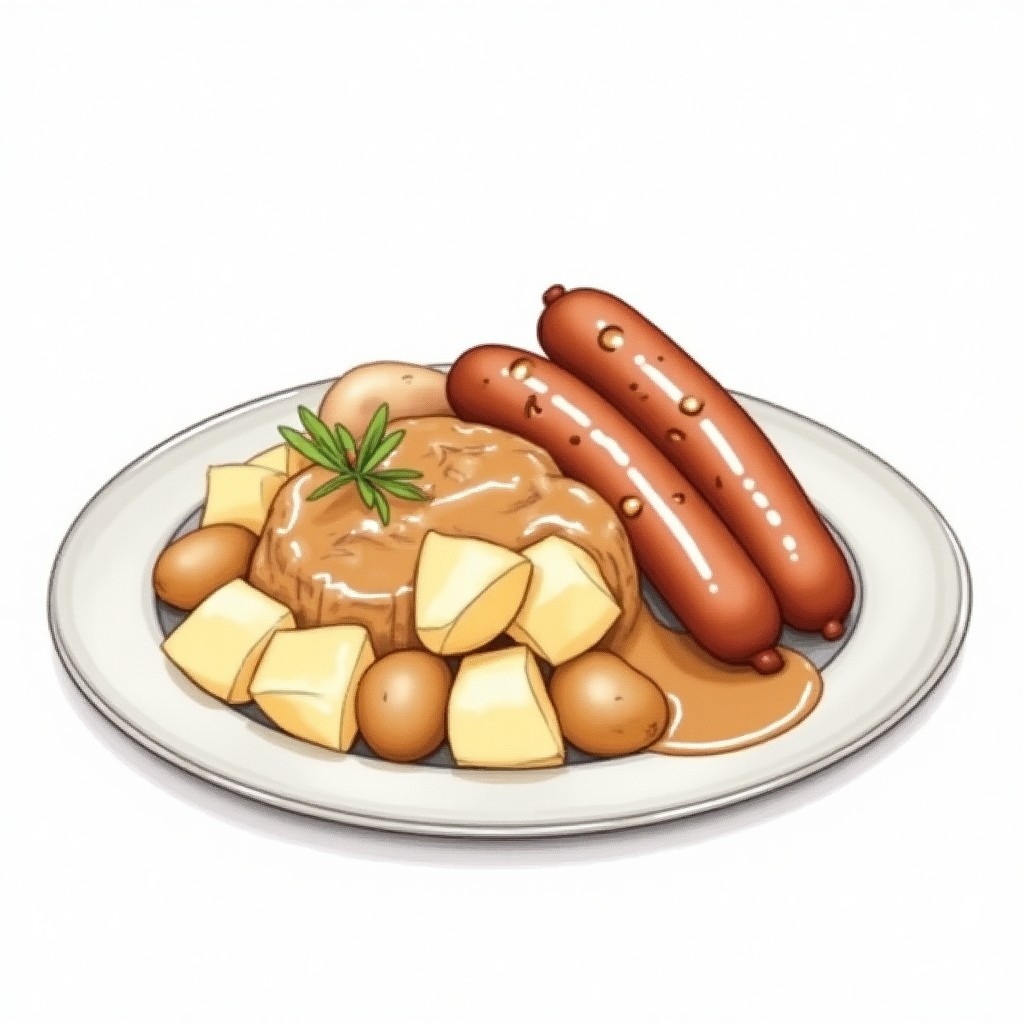
Traditional Bangers and Mash with Onion Gravy
Proper Bangers and Mash — Britain's Ultimate Comfort Plate
Few dishes deliver comfort quite like this British pub staple, where plump sausages nestle into pillowy mashed potatoes under a blanket of deeply caramelized onion gravy. The secret lies in taking your time with each component — really good mash needs patience, and that gravy depends on properly golden onions.
Walk into any proper British pub on a cold evening and you'll inevitably spot someone hunched happily over a plate of bangers and mash, fork cutting through plump sausages while gravy pools in the valleys of creamy potatoes. It's the kind of meal that makes you understand why comfort food exists — nothing fancy, just three simple components working together to create something greater than the sum of their parts.
The genius of bangers and mash lies in its balance. The sausages provide savory richness, the mash offers creamy comfort, and that onion gravy — deeply caramelized and glossy — ties everything together with its sweet-savory depth. Each forkful should give you all three flavors, which is why the proportions matter. Too much mash and you lose the sausage; too little gravy and everything feels dry.
What elevates this dish from cafeteria slop to pub perfection is patience with each component. The potatoes need proper boiling until they're completely tender, then careful mashing with good butter and warm milk. The onions for the gravy require slow cooking until they turn golden and sweet — rushing this step means missing out on the complex flavors that develop during that gentle caramelization. Even the sausages deserve attention, getting properly browned on all sides so their casings develop that satisfying snap.
Nutrition
Ingredients
- 8 linksthick pork sausages (traditional Cumberland or similar)
- black pepper to taste
Mashed Potatoes
- 2 lbrusset potatoes, peeled and quartered
- 4 tbspbutter
- ½ cupwhole milk, warmed
- 1 tspsalt
Onion Gravy
- 2 largelarge onions, thinly sliced
- 2 tbspbutter
- 2 tbspall-purpose flour
- 2 cupbeef stock, preferably low-sodium
- 1 tspWorcestershire sauce
Instructions
- Drop the potatoes into a large pot and cover with cold, generously salted water — about a tablespoon of salt does the job. Bring to a vigorous boil over high heat. Starting with cold water ensures even cooking from the outside in.⏱ 10 min
- Let the potatoes bubble away until they're completely tender when pierced with a fork — no resistance at all. This usually takes 15-20 minutes depending on size. Properly cooked potatoes are the foundation of great mash.⏱ 20 min
- While potatoes cook, arrange the sausages in a large skillet over medium heat. Turn them every few minutes to brown evenly on all sides. They're done when the casings are deep golden and the internal temperature hits 160°F — about 15 minutes total.⏱ 15 min
- Transfer the sausages to a warm plate and tent loosely with foil. Don't clean that skillet — those browned bits are pure flavor gold for your gravy.
- Add butter to the same skillet and toss in the sliced onions. Cook over medium heat, stirring occasionally, until they turn a beautiful caramel color. This takes patience — about 15 minutes — but it's where the gravy gets its depth.⏱ 15 min
- Sprinkle the flour over the golden onions and stir constantly for 2 minutes. The flour needs to cook out its raw taste and form a smooth paste with the onions — this is your roux.⏱ 2 min
- Pour in the beef stock gradually, whisking constantly to prevent lumps. Add the Worcestershire sauce and let everything simmer until the gravy coats the back of a spoon — about 5 minutes. It should be thick enough to cling to the sausages.⏱ 5 min
- Drain the potatoes thoroughly and return them to the hot pot. Mash until completely smooth — a potato masher works fine, but a ricer gives the silkiest results.
- Beat the butter into the hot potatoes first, then gradually add the warm milk until you reach a creamy, fluffy consistency. Stir in the salt and taste — good mash should be rich and well-seasoned.
- Taste the gravy and adjust with salt and pepper as needed. It should be savory and rich with a slight tang from the Worcestershire.
- Spoon the mashed potatoes onto warmed plates, nestle the sausages alongside, and ladle that gorgeous onion gravy over everything. Serve immediately while it's all piping hot.
Tips & Tricks
- Save the sausage drippings in your skillet — they're essential for building flavor in the onion gravy, so don't wipe the pan clean.
- Warm your milk before adding it to the mashed potatoes; cold milk will cool down your spuds and make them gluey instead of fluffy.
- If your gravy gets too thick, whisk in a bit more stock; if it's too thin, let it simmer uncovered for a few more minutes.
- Use a potato ricer if you have one — it creates the smoothest, lightest mash without overworking the starches.
- Leftover bangers and mash reheats beautifully in the microwave, though you might need to add a splash of milk to refresh the potatoes.
Frequently Asked Questions
What kind of sausages work best for this?
Traditional pork bangers are ideal — look for ones with higher fat content as they'll brown better and taste richer. Italian or bratwurst sausages work well too if you can't find proper British bangers.
Can I make the components ahead of time?
The mashed potatoes can be made up to 2 hours ahead and kept warm in a low oven, covered with foil. The gravy can be made earlier in the day and reheated gently, though you may need to whisk in a bit more stock if it thickens too much.
My gravy turned out lumpy — how do I fix it?
Strain the gravy through a fine-mesh sieve, pressing the solids with a spoon. If it's still lumpy, blend it with an immersion blender for 30 seconds until smooth.
What can I substitute for beef stock?
Chicken stock works fine and will give you a lighter gravy. Vegetable stock is acceptable too, though the flavor won't be quite as rich. Avoid using water — the gravy will taste flat.