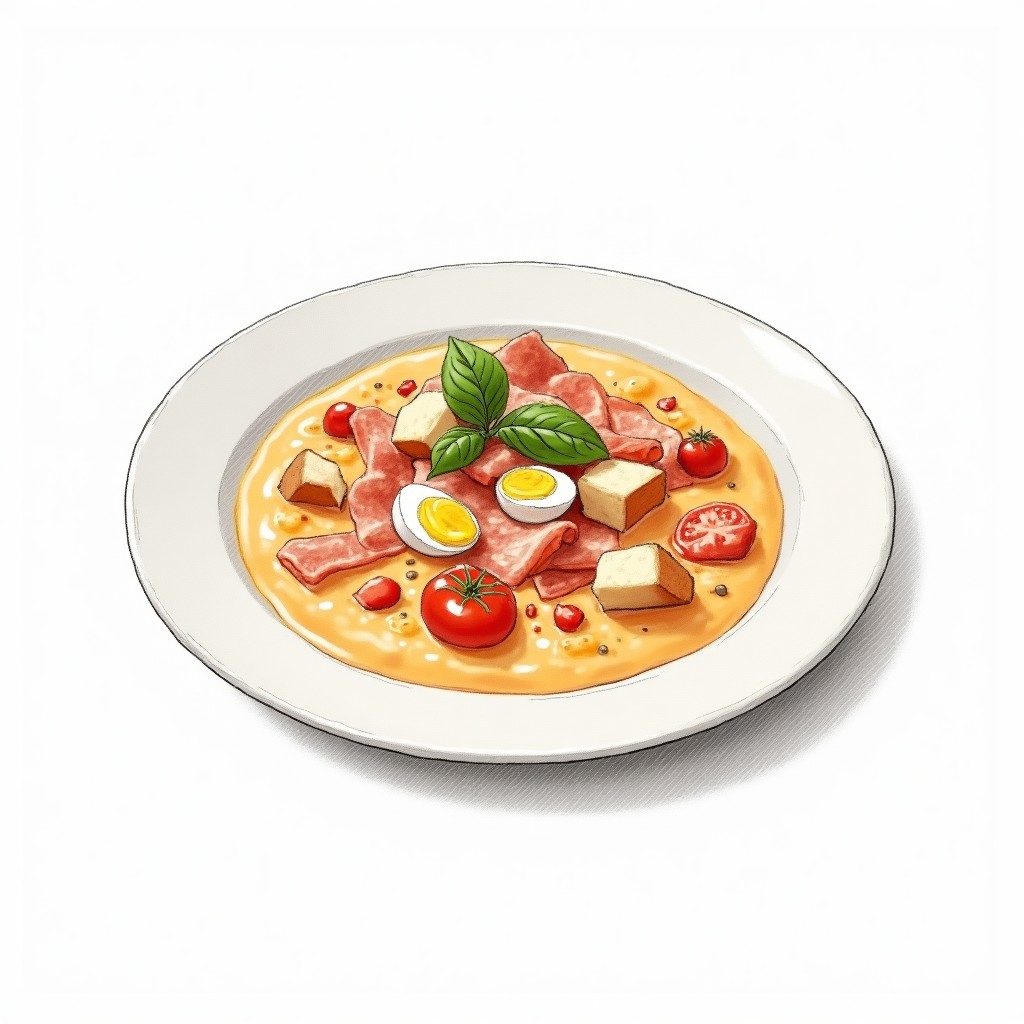
Traditional Andalusian Salmorejo
Silky Andalusian Salmorejo with Jamón and Eggs
Think of this as gazpacho's richer cousin — day-old bread transforms ripe tomatoes into something luxuriously thick and velvety. The final result is pure Andalusian comfort, meant to be lingered over with good company and perhaps a glass of fino sherry.
Salmorejo arrived in Córdoba long before anyone thought to call it soup, born from the practical need to transform yesterday's bread and summer's abundance of tomatoes into something sustaining. What emerged was pure alchemy — stale bread disappears entirely, melting into tomatoes to create a texture so velvety it coats your spoon like silk.
This isn't the chunky gazpacho most people know. Salmorejo commits fully to smoothness, achieving a consistency somewhere between soup and sauce through the magic of proper emulsification. The bread doesn't just thicken — it becomes the very foundation that allows olive oil to bind with tomato juices in ways that seem almost impossible. Each spoonful should feel luxurious without being heavy.
The garnishes aren't afterthoughts but essential contrasts — the jamón provides bursts of salt and chew against all that smoothness, while chopped hard-boiled eggs add richness and visual appeal. Andalusians serve this cold in small portions, understanding that something this concentrated deserves to be savored slowly, preferably in the shade on a blazing afternoon.
Nutrition
Ingredients
- 2 lbripe tomatoes, preferably vine-ripened
- 4 ozday-old white bread, crusts removed
- ½ cupextra virgin olive oil, Spanish preferred
- 2 clovegarlic cloves, peeled
- 1 tspkosher salt
- 1 tbspsherry vinegar
Garnish
- 2 hard-boiled eggs, chopped
- 4 ozjamón serrano, diced small
Instructions
- Remove the cores from your tomatoes and cut each one into quarters. Don't worry about being precise — they're going in the blender anyway.
- Break the bread into rough chunks and submerge in a bowl of cold water. Let it sit for 5 minutes until the bread is completely saturated and squishy.⏱ 5 min
- Lift the soaked bread from the water and squeeze it firmly in your hands to remove as much liquid as possible. You want it damp but not dripping.
- Pulse the tomatoes, squeezed bread, garlic, and salt in your food processor until the mixture is completely smooth and no chunks remain. This takes about 2 minutes of steady processing.
- Keep the processor running and pour the olive oil in a thin, steady stream through the feed tube. The mixture should become noticeably lighter and creamier as it emulsifies.
- Add the sherry vinegar and pulse just a few times to blend it in. You want to preserve that silky texture you just created.
- Push the entire mixture through a fine-mesh sieve using the back of a spoon, pressing the solids to extract every bit of liquid. This step gives you that signature smooth texture.
- Cover and refrigerate until thoroughly chilled — at least 2 hours. The flavors will meld and deepen while it chills, and the consistency will become perfectly spoonable.⏱ 2 hrs
- Ladle into chilled bowls and arrange the chopped eggs and diced jamón on top. A final drizzle of good olive oil wouldn't hurt either.
Tips & Tricks
- Use the ripest tomatoes you can find — their natural sweetness and acidity are what make salmorejo shine, and underripe tomatoes will leave you with a flat-tasting result.
- Day-old bread works better than fresh because it absorbs liquid more readily and breaks down completely during blending, creating that signature smooth texture.
- Don't skip the sieving step even if your food processor seems to have done a good job — those last few tomato skin bits will ruin the silky mouthfeel you're after.
- The olive oil needs to go in slowly while the processor runs to create a proper emulsion, just like making mayonnaise — rushing this step can cause the mixture to separate.
- Salmorejo tastes completely different after proper chilling time, so resist the urge to serve it immediately — the flavors need those few hours to marry and mellow.
Frequently Asked Questions
Can I make this without a food processor?
A high-powered blender works well, though you may need to work in batches and stop to scrape down the sides frequently. A regular blender struggles with the thick consistency, so add the ingredients gradually and be patient.
How long does salmorejo keep in the refrigerator?
It stays fresh for up to 3 days covered in the fridge, though the texture is best on the first day. Give it a good stir before serving since it may separate slightly over time.
What can I substitute for jamón serrano?
Prosciutto works perfectly as a direct substitute. For a less expensive option, try crispy pancetta or even good bacon, though you'll lose some of the delicate Spanish flavor.
Can I make this ahead for a party?
Absolutely — salmorejo actually improves after sitting overnight. Make it up to 2 days ahead and add the garnishes just before serving to keep the eggs and jamón from getting soggy.
Why is my salmorejo grainy instead of smooth?
Usually this means the bread wasn't soaked long enough or the mixture wasn't processed thoroughly before sieving. Make sure the bread is completely waterlogged and process for a full 2 minutes before straining.