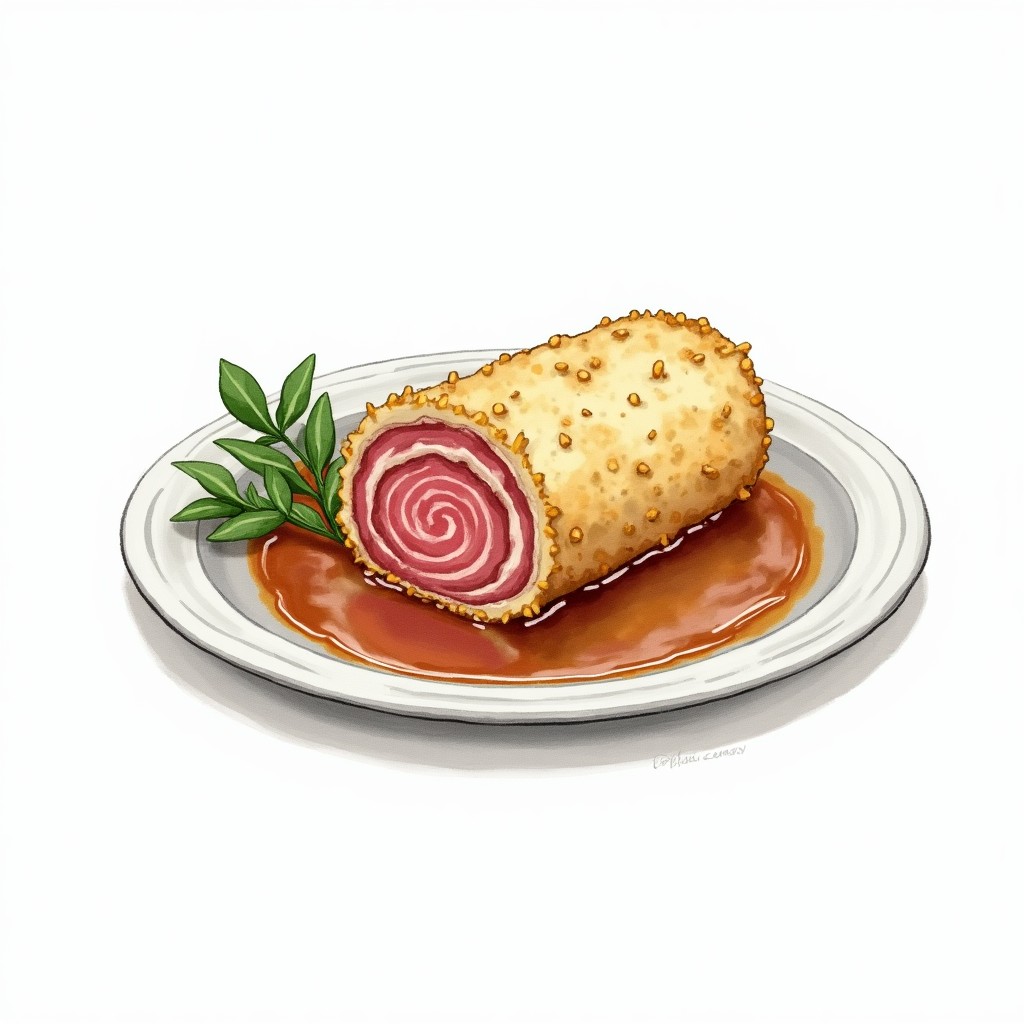
Italian Beef Braciole
Beef Braciole — Tender Rolled Cutlets Slow-Braised in Rich Tomato Sauce
Paper-thin beef gets wrapped around a savory mix of herbs, cheese, and breadcrumbs, then simmers away until fork-tender in wine-spiked tomato sauce. It's the kind of dish that fills your kitchen with the most incredible aromas while it cooks.
Every Italian grandmother has her own way of making braciole, but they all agree on one thing: the meat must be rolled so thin you can practically read through it. This technique transforms tough top round into something magical — each slice becomes a tender package that slowly surrenders to tomato and wine until it practically falls apart at the touch of a fork.
The dish originated in Southern Italy, where resourceful cooks learned to stretch affordable cuts into something special for Sunday dinner. The filling varies from region to region — some add pine nuts and raisins, others include hard-boiled eggs — but the principle remains constant: good ingredients, careful preparation, and patience. The rolling and tying might feel fussy at first, but it's what keeps everything together during the long, gentle braise.
What I love most about braciole is how it transforms your kitchen. The initial browning creates those deep, caramelized flavors that will permeate the sauce, while the slow oven cooking fills the house with the kind of aroma that makes neighbors linger in the hallway. It's comfort food that happens to be elegant enough for company, the kind of dish that proves the best Italian cooking isn't about complexity — it's about understanding how time and heat work their magic on simple, quality ingredients.
Nutrition
Ingredients
- 2 lbbeef top round, sliced 1/4-inch thick
- kitchen twine
Filling
- 1 cupfine breadcrumbs
- ½ cupfreshly grated Parmesan cheese
- ¼ cupfresh flat-leaf parsley, finely chopped
- 2 clovegarlic cloves, minced
- ¼ cupextra-virgin olive oil
- 1 tspkosher salt
- ½ tspfreshly ground black pepper
Braising
- 2 tbspolive oil
- 1 mediumyellow onion, diced
- 28 ozcrushed tomatoes
- ½ cupdry red wine
- 1 tspdried oregano
- 1 tspkosher salt
Instructions
- Place each beef slice between sheets of plastic wrap and pound gently with a meat mallet until you reach 1/8-inch thickness. The meat should be thin enough to roll easily but not so thin it tears.
- Combine the breadcrumbs, Parmesan, parsley, garlic, olive oil, salt, and pepper in a bowl, mixing until the olive oil is evenly distributed and the mixture holds together when pinched.
- Lay each beef slice flat and spread 2 tablespoons of filling evenly across the surface, leaving a small border. Roll each piece tightly from one end, then secure with kitchen twine at both ends and once in the middle.
- Preheat your oven to 325°F. Heat the olive oil in a heavy Dutch oven over medium-high heat until it shimmers and moves freely across the bottom of the pot.
- Add the braciole and turn them every 2 minutes to brown evenly on all sides — you want a deep golden color that will add richness to the final sauce. Remove to a plate.⏱ 8 min
- Lower the heat to medium and add the diced onion to the same pot. Cook, stirring occasionally, until the onion is soft and translucent but not browned.⏱ 5 min
- Pour in the crushed tomatoes, wine, oregano, and salt, scraping up any browned bits from the bottom of the pot. Bring the mixture to a gentle simmer.
- Nestle the braciole back into the sauce, cover the pot with a tight-fitting lid, and slide into the oven. The low, slow heat will make the beef incredibly tender.⏱ 2 hrs
- Carefully snip and remove all the twine before slicing and serving. The braciole should cut cleanly with a fork and the sauce should be rich and slightly thickened.
Tips & Tricks
- Ask your butcher to slice the top round for you at 1/4-inch thickness — it saves time and ensures even pieces that will cook uniformly.
- If the filling seems too dry and won't hold together when pinched, add olive oil one teaspoon at a time until it just binds.
- Don't skip the browning step even though it adds time — those caramelized bits on the bottom of the pot become the foundation of your sauce's flavor.
- The braciole is done when you can easily pierce it with a fork and twist without resistance, usually after about 2 hours in a 325°F oven.
- Let the braciole rest in the sauce for 10 minutes before removing the twine — this prevents the filling from spilling out when you slice.
Frequently Asked Questions
Can I make this ahead of time?
Yes, braciole actually improves after a day in the refrigerator. Cook it completely, cool, and refrigerate in the sauce for up to 3 days. Reheat gently in a covered pot over low heat.
What can I substitute for the red wine?
Use additional crushed tomatoes or beef broth if you prefer to avoid wine. The wine adds depth, but the dish will still be delicious without it.
My meat tore while pounding — can I still use it?
Small tears are fine and won't affect the final dish. For larger tears, overlap the edges slightly when adding the filling and roll carefully to keep everything contained.
Can I freeze cooked braciole?
Absolutely. Cool completely in the sauce, then freeze in portions for up to 3 months. Thaw overnight in the refrigerator and reheat gently on the stovetop.